Why Does Glass Get Water Marks? The Real Reason Your Shower Screen Turns White
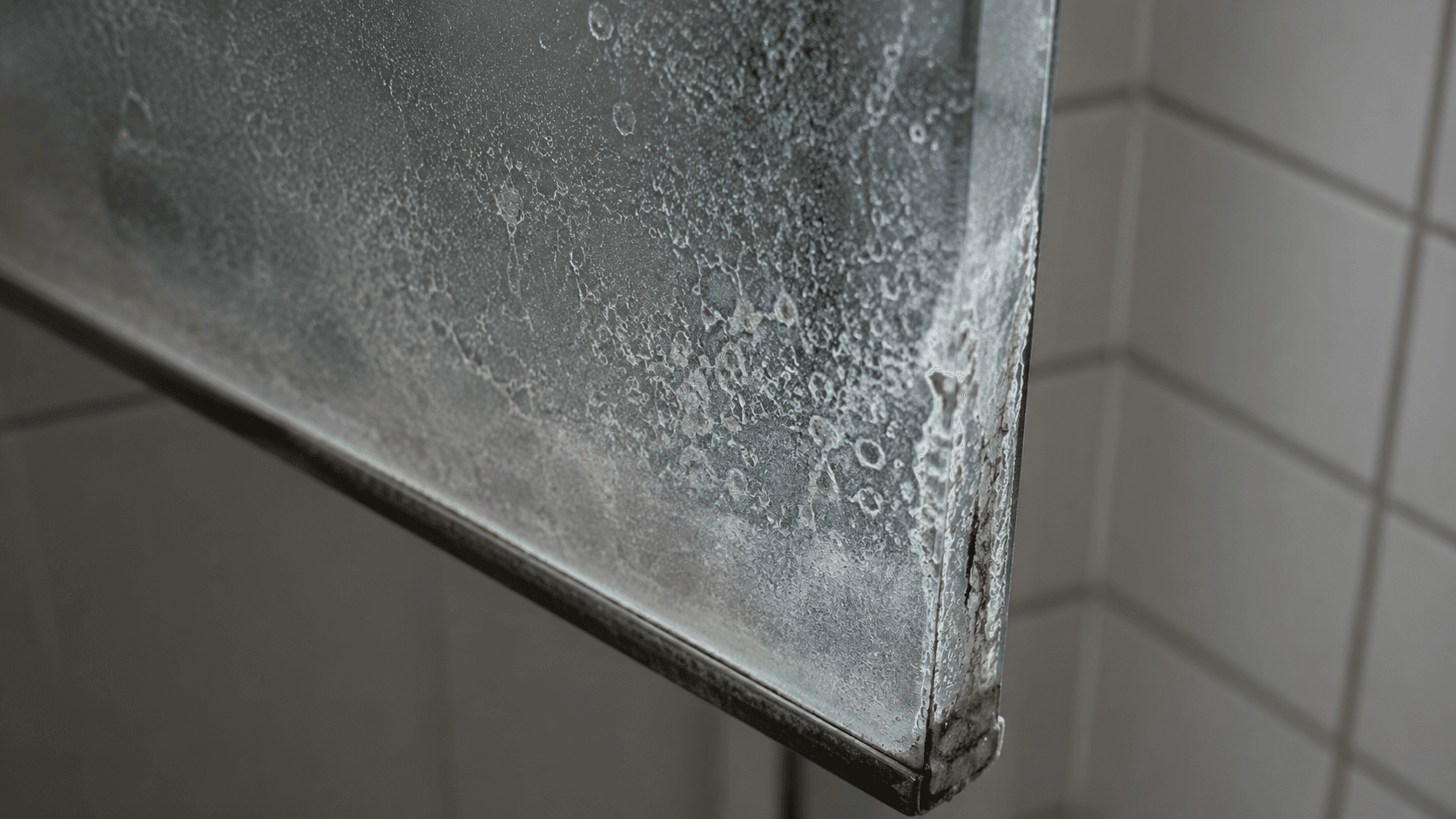
Water marks are not dirt sitting on your glass. They start inside the glass itself. When a thin film of water dries on a shower screen, the glass leaks sodium into that film, the film turns alkaline as it dries, and once it passes pH 9 it begins dissolving the glass surface. That is why a fish tank full of water stays clear while your shower screen turns white, and why cleaning stops working once the damage is in the surface instead of on it.
Start with something that does not add up.
A fish tank sits full of water, 24 hours a day, for years. The glass stays clear.
Your shower screen gets wet for maybe 10 minutes a day. In two years it is white, and you cannot clean it off.
Same water. Same kind of glass. Completely different result.
So the problem is not "water". It is something more specific than that, and once you see it, the whole thing makes sense: why it got worse, why your cleaner stopped working, and why scrubbing harder made it worse instead of better.
What is actually happening to your glass
Three steps. All three are documented by glass manufacturers and an industry association, not by us. Links to every source are at the bottom of this page.
Step 1. Your glass leaks sodium into the water
Shower screens and windows are made of soda-lime glass. There is sodium sitting inside it. When water touches it, the water pulls some of that sodium out.
"Water readily leaches, or takes, sodium ions from soda-lime-silica glasses."
Vitro Architectural Glass, Technical Document TD-105
Nothing has gone wrong yet. This happens to every piece of glass on earth that touches water, including your fish tank.
Step 2. The film dries, and the alkali gets concentrated
This is the step that explains the fish tank, and it is the step almost nobody talks about.
In a fish tank, there is a huge volume of water. Whatever sodium leaves the glass gets diluted into all of it. The water never gets strong enough to do anything.
On your shower screen there is a thin film, and that film is drying. The water leaves. The sodium does not. Less and less water, same amount of sodium. The film gets more and more alkaline as it dries.
Once it passes pH 9, it stops being harmless:
"Once solution pH levels reach 9.0 or greater... hydroxide ion concentration is sufficient to begin attack of the silicate network... the main reaction is the severing of silicon-oxygen bonds (the glass itself is slowly dissolved)."
Vitro Architectural Glass, TD-105
The same document reports lab measurements of films reaching pH 9.9, which is strongly alkaline.
Read that last line again: the glass itself is slowly dissolved. Not coated. Not covered. Dissolved.
Step 3. The surface turns rough, and now it holds dirt
When those bonds break, the smooth surface is gone. What replaces it is a rough, spongy layer.
The altered surface becomes "a Si-rich hydrated and porous layer, called a gel."
npj Materials Degradation (Nature Portfolio), 2021 review
Notice the order, because most articles online get it backwards. Glass does not start out full of tiny holes. It becomes porous after it gets attacked. The holes are the damage. They are not the cause.
And this is exactly what the shower screen industry says about shower screens specifically:
"Continuous wetting and drying may cause an increase in the alkalinity of the glass surface initiating ‘glass corrosion’. This may give rise to noticeable cloudy appearances."
Australian Glass and Window Association, Shower Screens technical fact sheet, 2021
Why a shower is the worst possible place to put glass
Here is the fair version of the story, including the part that argues against us.
Vitro also says that installed glass usually does not corrode, because water on it "either quickly evaporates or is highly diluted by normal weathering conditions."
That is true, and it is why your living room window is fine. Rain hits it, runs off, gets diluted, dries fast in the open air. The sodium never gets a chance to build up.
A shower cubicle is the opposite of that on every count.
| Where the glass is | What the water does | Result |
|---|---|---|
| Fish tank | Huge volume, never dries. Sodium gets diluted into litres of water | Stays clear for years |
| Outside window | Rain runs off, dries fast in open air, gets rinsed again next time it rains | Mostly fine |
| Shower screen | Thin film. Closed room, humid, poor airflow, so it dries slowly. Nothing rinses it. Repeats every single day | Goes cloudy |
The variable is not how much water. It is whether the water is disappearing while it is still sitting on the glass. A shower cubicle in Malaysia, where the air is humid all year and most bathrooms have one small exhaust fan, is about the slowest-drying place you could pick.
"But my water is hard, right?"
That is the answer you will find on almost every site, because most of those sites are written for the US, the UK or Australia. In the Klang Valley it does not hold up.
Tap water in Kuala Lumpur was measured across 20 areas at 48 to 92 mg/L CaCO3, averaging 65. Anything under 100 is classed as soft water.
Source: Ong, Ibrahim & Gupta, A Survey of Tap Water Quality in Kuala Lumpur, Urban Water Journal, 2007
And it is close to neutral. The Ministry of Health standard is pH 6.5 to 9.0, and measured KL tap water sits around 7.7.
So the water leaving your tap is soft, and it is roughly neutral. It is not attacking anything.
The alkaline film that eats your glass is not delivered by your water. Your glass makes it.
Soap scum is the same story. Soap scum is calcium and magnesium stearate, and it needs the calcium and magnesium in hard water to form at all. On top of that, most people here use shower gel rather than bar soap, and shower gel is a synthetic surfactant that does not precipitate like that. It is a bit player in Malaysia, not the villain.
Why your cleaning stopped working
Guardian Glass, one of the largest float glass makers in the world, describes a damaged glass surface like this: it is "covered in microscopic mountains and valleys."
That is the right picture, and it is worth sitting with for a second. Not a flat sheet with a few holes in it. A landscape. Peaks and valleys, all the way across.
Your cloth is flat and soft. It presses on the peaks. It cannot reach the bottom of the valleys, and the valleys are exactly where the stain now lives.
This is why everyone climbs the same ladder and everyone gets stuck at the top of it:
- Normal glass cleaner
- White vinegar and baking soda
- Cif cream (about RM6.50)
- A Daiso melamine sponge
- A watermark remover off Shopee (about RM21.90)
- Cement remover or another strong acid from the hardware shop
- Steel wool
Every rung is more aggressive than the last, and not one of them can get to the bottom of a valley. The last two rungs actively make it worse: abrasives add scratches, and every scratch is one more place for stain to sit. That is why some people find the glass looks worse after a big scrub than it did before.
If you have already been through that list, nothing was wrong with your technique. You were trying to clean something that is not sitting on top of the glass.
A 10-second test you can do tonight
Splash water over the glass. Look at it while it is wet. Then let it dry and look again.
If the white haze disappears when the glass is wet and comes back when it dries, the damage is in the surface, not on it.
This is not our clever test. It is how people describe the problem themselves. From a Malaysian forum thread about exactly this: "If I pour water over it, it is not visible."
The reason it works: water fills the valleys, so light passes through evenly again and the glass looks clear. When it dries, the rough surface scatters light and you see white.
Second test, using your fingernail. Run it lightly across a hazy patch. If it feels smooth, you are probably still dealing with deposits sitting on top. If it catches or feels gritty, the surface itself has been eaten.
So what can you actually do
Being honest about this matters more than selling you something, because the answer is genuinely different depending on where your glass is right now.
| Where your glass is | What actually works | Roughly what it costs |
|---|---|---|
| Still clear. New glass, or a recent renovation | Stop the film from drying on it. Either squeegee every single time you shower, or put a coating on the glass so the water runs off before it can dry | A squeegee is under RM30. A DIY coating kit is RM238 for one bathroom |
| Slightly hazy, still feels smooth | A proper clean can usually still get it back. Then protect it, because the next round starts the day after you finish | Cleaner plus your time |
| Feels rough or gritty | No cleaner reaches it. The only thing that removes it is mechanical polishing, which works by grinding off a thin layer of the glass itself. After that the fresh surface is exposed and the clock starts again | Quoted per panel by specialists. For comparison, a new framed shower screen starts around RM861 at Reliance Home |
The uncomfortable part: the cheapest day to deal with this is the day the glass is still perfect, which is also the day it feels least urgent. By the time it looks bad enough to act on, the cheap options are gone.
We sell a coating, so of course we would say that. But you do not need to buy anything from us to act on it. A squeegee and 15 seconds after every shower does the same job. The trade-off is that you have to do it every time, for years, and everybody in the house has to do it too. That is the honest comparison.
Where all of this comes from
Every claim on this page is traceable. Here are the actual documents, so you can check them yourself.
- Vitro Architectural Glass, TD-105 "How to Prevent Glass Corrosion". The sodium leaching, the pH 9.0 threshold and the silicon-oxygen bonds being severed.
- Australian Glass and Window Association, Shower Screens: Guidance on Care and Maintenance (2021). Wetting and drying raising surface alkalinity, written specifically about shower screens.
- Aqueous alteration of silicate glass, npj Materials Degradation (2021). The porous gel layer forming as a result of attack.
- A Survey of Tap Water Quality in Kuala Lumpur, Urban Water Journal (2007). Hardness of 48 to 92 mg/L CaCO3.
- Ministry of Health Malaysia, National Drinking Water Quality Standards. The pH range for Malaysian tap water.
- Guardian Glass, ShowerGuard. The "microscopic mountains and valleys" description of a damaged surface.
Kent, EnduroShield Malaysia
Not sure which stage your glass is at?
Leave your email and RM20 comes off your first order right away (free shipping too), plus we send you our Glass Care Guide that walks you through the fingernail test and what to do at each stage.
Take RM20 off →Frequently asked questions
Is this the same thing as hard water stains?
Not in Malaysia. Hard water stains are mineral deposits left behind by water that carries a lot of calcium and magnesium. Kuala Lumpur tap water was measured at 48 to 92 mg/L CaCO3, which is classed as soft. What you are looking at on a Malaysian shower screen is mostly damage to the glass surface itself, not a mineral crust sitting on top of it. That is also why the removers that work overseas often do very little here.
Can a coating remove the water marks I already have?
No, and anybody who tells you otherwise is going to disappoint you. A coating goes on top of a clean surface. If the surface underneath has already been eaten, the coating cannot fill it in or reverse it. Do the fingernail test first. If the glass feels rough, it needs mechanical polishing before any coating is worth doing.
How long does new glass take before it starts going cloudy?
There is no fixed number, and anyone quoting you one is guessing. It depends on how often a film of water is left to dry on the glass, how well the bathroom is ventilated, and how quickly it dries. A screen in a small windowless bathroom used by four people will age much faster than one in a ventilated bathroom used twice a week. What is consistent is the direction: it only goes one way, and it does not repair itself.
Does a squeegee actually work, or is it just something people say?
It genuinely works, and it is the free version of the same idea. The mechanism on this page is about water drying on the glass, so if you remove the water before it dries, the mechanism does not run. The catch is that it has to be every shower, by everybody in the house, for years. Most people manage it for a few weeks.
Should I install a water filter or a softener for this?
For this specific problem, probably not. A whole-house softener is a significant spend, and the KL measurements say the water is already soft and close to neutral. The alkaline film that damages the glass forms on the glass, from the glass, as the water dries. Softening water that is already soft does not change that.