Is Malaysia's Tap Water Hard or Soft? (And Why Your Shower Glass Still Spots)
Most of Malaysia's treated tap water is relatively soft to moderately hard, softer than places like the US or the Middle East. But even moderately hard water, plus daily hot showers and high humidity, still leaves mineral and soap spots on bare shower glass. A whole-house water softener helps the whole home but is expensive and does not stop a thin film bonding to bare glass. The direct fix for the glass is a non-stick coating: EnduroShield lasts up to 3 years DIY from RM238, TUV Rheinland certified since 2011, and cuts cleaning by about 90%.
If your shower glass keeps spotting, the first thing almost everyone blames is the water. "Our water mesti very hard one, that is why the glass so cloudy." It sounds logical, but here in Malaysia the real story is a bit more nuanced. Most of our treated town water is not actually that hard, yet the glass still hazes over after a few months. So what is really going on?
I am Kent from EnduroShield Malaysia, and I get this question almost every week. Let me walk you through what Malaysian tap water is genuinely like, why even soft water still leaves spots, and the cheapest, most direct way to stop it.
Is Malaysian tap water actually hard?
Mostly, no. The treated tap water piped into homes across the Klang Valley and most Malaysian cities is generally soft to moderately hard. Compared with places like the United States, parts of Europe, or the Middle East, our water sits on the softer end of the scale. If you have ever complained that soap "never seems to rinse off" while travelling in a very hard water country, you already know the difference.
That said, hardness is not the same everywhere. It changes with your source and your area. Water drawn near limestone hills, or from a private borehole or well, tends to carry more dissolved minerals and sits in the harder range. Older buildings and long pipe runs can also pick up scale along the way. So instead of quoting exact figures, which vary batch to batch and area to area, it is more honest to think in simple bands.
| Area type | Typical hardness | Shower glass risk |
|---|---|---|
| Major treated supply (Klang Valley, most cities) | Soft to moderate | Still spots in humid bathrooms |
| Limestone or borehole / well areas | Harder | Higher spotting |
| Older buildings or long pipe runs | Variable | More scale build-up |
Notice the pattern: even the softest band still spots. Hardness makes it worse, but it is not the whole reason your glass clouds up.
Then why does my glass still spot if the water is soft?
Because "soft" does not mean "no minerals". Even soft water carries a small amount of calcium, magnesium, and other dissolved solids. On its own that is harmless. The problem is what a Malaysian bathroom does to it every single day.
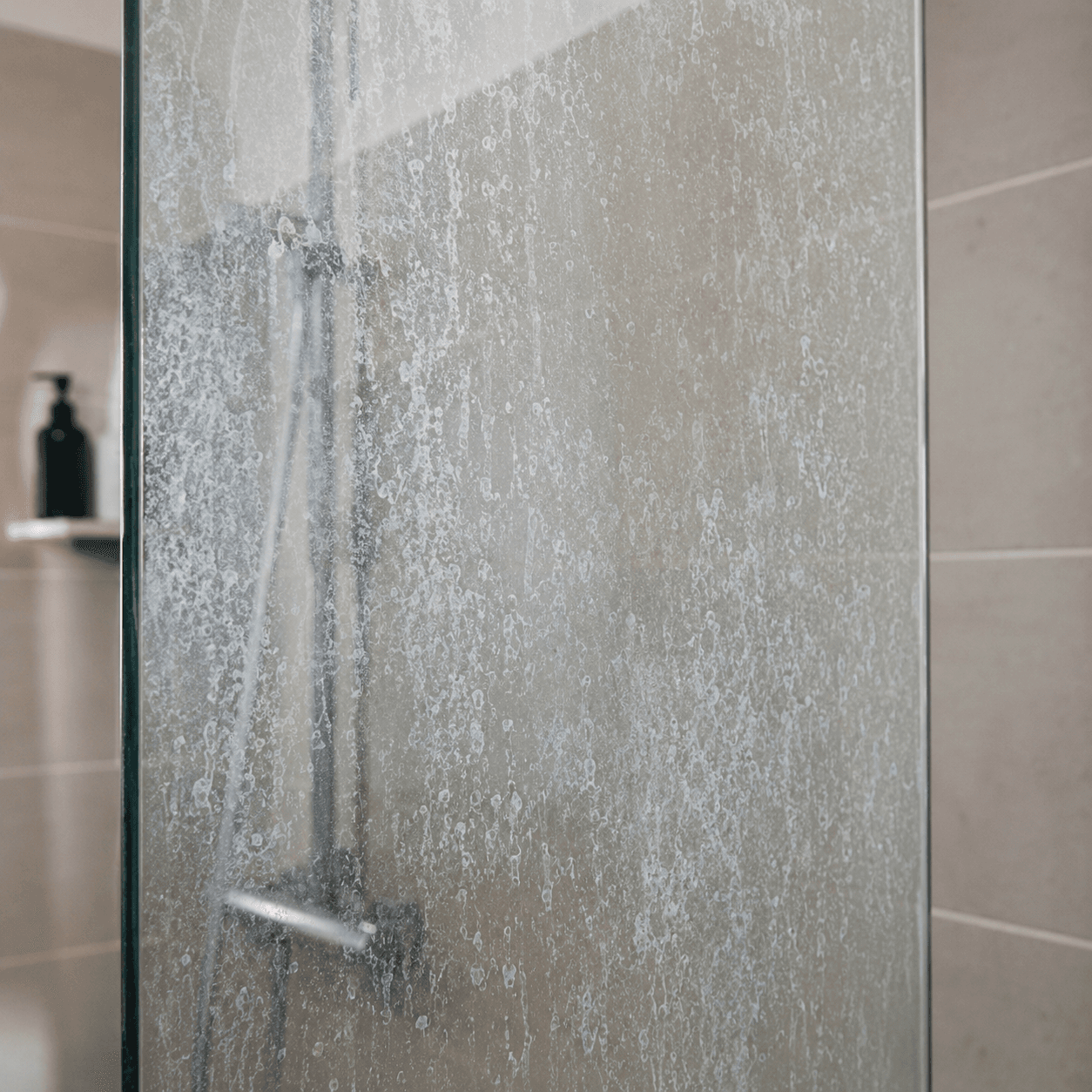
Think about the daily cycle. You run a hot shower, the water evaporates fast in our humid climate, and every droplet left on the glass dries into a tiny mineral dot. Add soap scum, shampoo, and hard-to-avoid body oils, and those dots build into a film. Bare glass is not perfectly smooth either; under a microscope it is porous, full of tiny peaks and valleys. Minerals settle into those gaps, and over the weeks they penetrate (渗透) and slowly etch the surface. That is the cloudy, rough, wipe-but-never-clear look you end up fighting.
So the spotting is really minerals plus heat plus soap plus humidity plus time, all concentrated on a bare, porous surface. Softer water just slows the clock a little. It does not stop it.
Do I need a water softener?
Honest answer: it depends on what you are trying to fix. A whole-house water softener does genuinely help your whole home. It is kinder on your pipes, your water heater, and your kettle, and some people feel it is gentler on skin and hair. If those are your goals, it can be a reasonable upgrade.
But for the shower glass specifically, a softener is overkill. It is a proper plumbing job that usually costs RM thousands to install, plus ongoing salt and maintenance. And here is the part the salespeople skip: even softened water still leaves a thin film that bonds to bare glass. You have spent big money and the glass still needs wiping. For the glass problem alone, sealing the glass is far cheaper and far more direct than treating every drop of water in the house.
If your main headache is the shower screen, the EnduroShield DIY glass coating kit tackles the surface itself, and you can protect your shower glass in an afternoon without touching your plumbing.
The direct fix: make the glass non-stick
Here is the reframe that saves people the most money. You do not need to soften the water. You need to change the glass so minerals cannot grab hold of it.
EnduroShield is a nano coating that bonds to the glass and makes it non-stick, the way a good frying pan repels a fried egg. It is both hydrophobic and oleophobic, so water beads off and oily soap scum has nothing to cling to. Minerals and soap slide off instead of settling in, which is why treated glass needs about 90% less cleaning. It is TUV Rheinland certified since 2011 (Certipedia 0000033462) and made by PCT Global under ISO 9001:2015 quality standards, so this is not a spray-and-hope gimmick.
The DIY kit is built for the average Malaysian shower. One kit covers roughly 40 sqft, costs from RM238, and takes about 10 to 30 minutes to apply, then 8 hours to cure. It lasts up to 3 years DIY, or up to 10 years with the professional application. After that, glass care is just a quick squeegee after your shower. No scrubbing, no harsh chemicals, no water softener.
One honest caveat. A coating prevents damage, it does not reverse it. If your glass is already etched, meaning it feels rough and stays hazy no matter how hard you wipe, the minerals have already gone into the surface. At that point you are looking at professional polishing from RM500, or replacement at roughly RM1,200 to RM3,000. Not sure which camp you are in? Here is how to tell if your glass is etched before you spend a cent. The whole point of coating is to seal the glass while it is still smooth, so you never reach that stage.
So, is Malaysia's water hard or soft? Mostly on the softer side, but that was never the real reason your glass spots. The fix is not softer water. It is glass that minerals cannot stick to. Seal it while it is new, wipe it in seconds, and forget about it for years.
Kent, EnduroShield Malaysia
Get RM20 off + free shipping on your first order
Leave your email. RM20 comes off your first order at checkout, no code to copy.
Take RM20 off →Frequently asked questions
Is Malaysia's tap water hard or soft?
Mostly soft to moderately hard. The treated town water in the Klang Valley and most Malaysian cities sits on the softer side compared with countries like the US or the Middle East. Hardness rises in limestone areas and where homes rely on borehole or well water, but even the softer supply still spots bare glass.
Why does my shower glass spot if the water is soft?
Because soft water still carries some minerals, and a hot, humid bathroom concentrates them. Every droplet that dries on bare glass leaves a mineral dot, and soap plus body oil builds a film that slowly penetrates (渗透) and etches the porous surface. Softer water only slows this down, it does not stop it.
Do I need a water softener to stop hard water stains on glass?
Not for the glass alone. A softener helps your whole home, pipes, and heater, but it is a plumbing job costing RM thousands, and softened water still leaves a film that bonds to bare glass. For the shower screen specifically, sealing the glass with a non-stick coating is cheaper and more direct.
Is hard water worse in Penang or Johor?
It depends more on your local source than the state name. Areas near limestone hills or relying on borehole and well water tend to have harder water, whether in Penang, Johor, or anywhere else, while most treated town supply stays on the softer side. Either way bare glass still spots, so the fix is the same.
What is the cheapest way to stop hard water spots on shower glass?
Seal the glass so minerals cannot stick. A non-stick coating like EnduroShield is the cheapest direct fix from RM238 for a DIY kit, lasts up to 3 years, and cuts cleaning by about 90%. A water softener costs far more and still leaves a film on bare glass.