Why Your Shower Glass Has White Spots (and What Actually Removes Them)
Those white spots are shower glass stains caused by hard-water minerals — here’s what actually removes them.
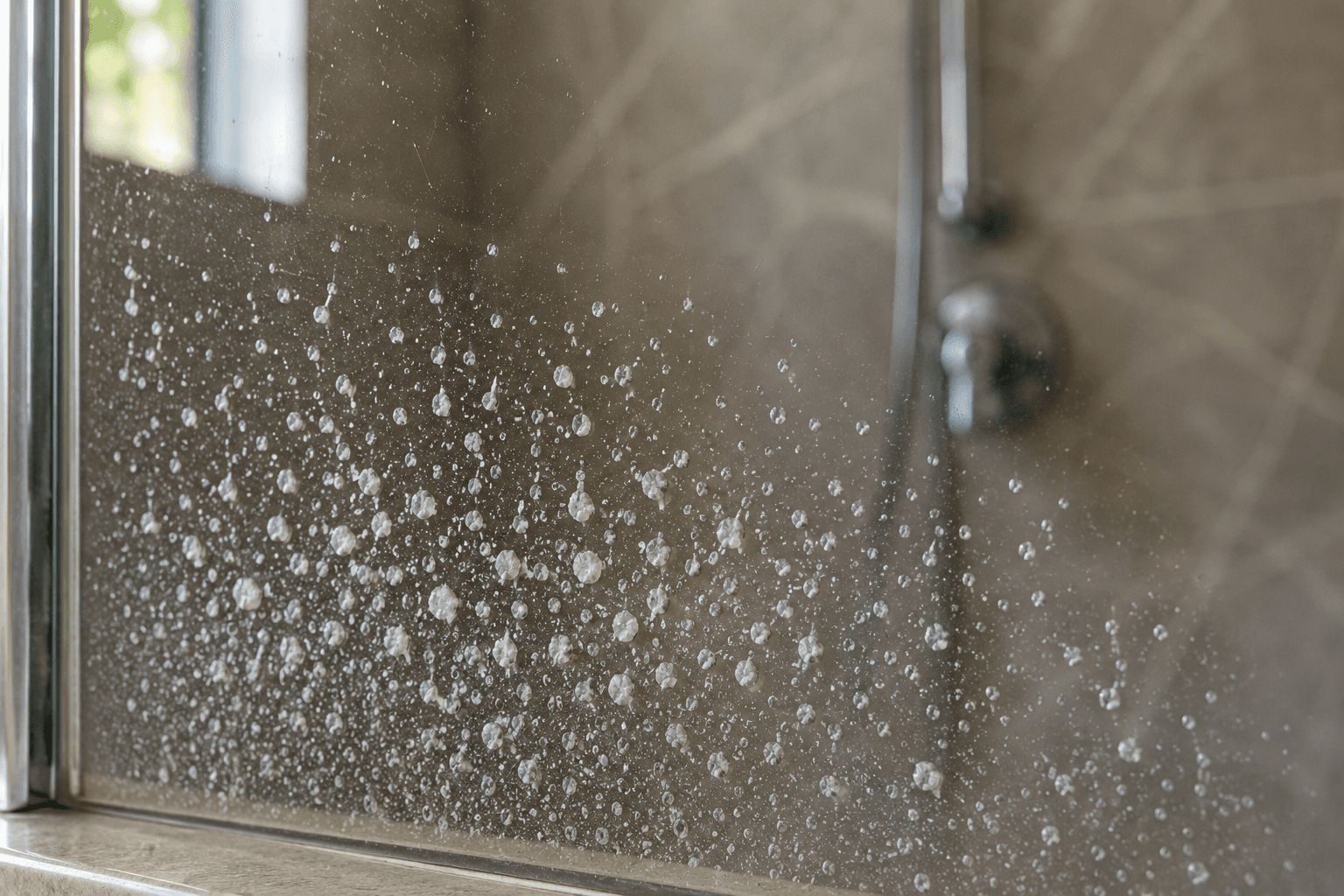
Those white spots are calcium and magnesium minerals from Malaysian tap water, left behind every time a droplet evaporates instead of being squeegeed off. Stage 1 (spots sitting on the surface): vinegar removes them in 8 minutes. Stage 2 (minerals fused into the silica): permanent. This guide explains the chemistry, the stage diagnostic, and what actually works at each stage.
Almost every Malaysian shower glass develops white spots within months of new installation. Most homeowners assume it’s dirt or soap scum and reach for the wrong product. The real cause is invisible chemistry happening every time water dries on the glass.
Here’s the actual mechanism, in plain language.
What the white spots actually are
Those white spots on your shower glass are two different things drying at the same time, and only one of them washes off.
The first is mineral. Malaysian tap water carries calcium and magnesium, and your soap and shampoo leave residue too. Dry that on the glass and it becomes the white film you can scrub at.
The second is the glass itself. Your shower glass is soda-lime glass, and about 13–16% of it by weight is soda (sodium oxide).
Water left sitting on it pulls sodium out of the surface and turns alkaline. Once it turns alkaline enough, it penetrates the glass surface and leaves pits far too small to see one by one. Together they scatter light, and that is the haze that will not come off no matter how hard you scrub.
So if your white spots wipe away, you are dealing with mineral. If they stay after a proper clean, it has already gone into your glass.
When that water hits the shower glass and then evaporates, the calcium and magnesium can’t evaporate with it — they crystallise back into solid form. That’s the white deposit you see.
The chemistry is the same one that creates hard scale inside your kettle. Glass is just a slower target because it’s smoother to start with.
Stage 1 vs Stage 2: do the 5-second test
Not all white spots are the same problem. Before you buy anything or scrub anything, run this diagnostic.
The test: Stand close to the glass. Pick one spot. Run your fingernail across it.
Stage 1 — FIXABLE (the spot feels rough or bumpy under your nail)
- Minerals are still on the surface of the glass.
- Vinegar dissolves them in 5-8 minutes.
- Glass will return to clear.
Stage 2 — PERMANENT (the spot feels smooth, but the glass looks foggy or hazy)
- Minerals have chemically fused into the silica.
- Vinegar will not work. Soap will not work. Scrubbing will not work.
- Only polishing or replacement restores clarity.
Most Malaysian shower glass crosses from Stage 1 to Stage 2 between month 12 and month 24 of daily use without protection.
Stage 1 fix: vinegar method (8 minutes)
Stage 1 spots come off easily if you use the right chemistry. Vinegar is mildly acidic. Calcium minerals dissolve in mild acid. That’s the whole science.
- Mix 1:1 white vinegar (about RM 3.50, sundry shop) + warm water in a spray bottle.
- Spray the affected area. Lightly wet, not dripping.
- Wait 5 minutes. Most people don’t wait long enough. The vinegar needs time to react.
- Wipe with a microfibre cloth in straight downward strokes. Never circles.
- Rinse with plain warm water (this matters — vinegar residue attracts dust).
- Squeegee dry top to bottom.
One panel takes about 8 minutes. The glass should return to fully clear. If it doesn’t after one try, try the soak method: soak a paper towel in undiluted vinegar, press against the spot for 15 minutes, then wipe.
Stage 2: when vinegar can’t fix it
If you’ve done the vinegar method 3-4 times across consecutive weekends and the cloudiness is still there, the minerals have fused into the glass surface. This is permanent damage. Three options.
- DIY cerium polishing kit (RM 80-150 on Shopee). Cerium oxide is the same compound used by professionals. The kit comes with powder, felt pad, and instructions. Realistic time: 2 hours per panel. Best for shallow etching.
- Professional glass restoration (RM 500-1,200/panel). A pro polisher uses industrial cerium machines — does in 20 minutes what DIY takes 2 hours, with better consistency. Best for deep etching or large panels.
- Replace the panel (RM 1,200-3,000). If etching is severe across multiple panels, this can be cheaper than polishing all of them.
None of these are pleasant to pay for, which is why the next section matters.
The single thing that prevents Stage 2
The reason white spots progress from Stage 1 to Stage 2 is repeated cycles of mineral deposition without removal. Each time minerals deposit, sit there for a day or two, and then get pushed off by water flow, a tiny percentage migrates deeper into the silica each cycle.
To stop this, you only need to break the cycle once a day. The 30-second squeegee habit does exactly this:
- After every shower, take a squeegee (Vileda 27cm, RM 19.90 at Tesco) and pull straight down across the glass.
- One pass top-to-bottom. About 6-8 strokes for a 90cm panel.
- 30 seconds total.
This removes 95% of the water and minerals before evaporation begins. Daily for 18 months prevents Stage 2 from happening.
If you can’t commit to the daily habit, the alternative is a glass coating like EnduroShield. The coating fills micro-pores in the glass surface so minerals can’t bond. Lasts about 3 years per application. See the DIY kit details. Either way: prevention costs less than cure.
Want free delivery on your first order?
Drop your email. We send you the code now, and you use it on your first order.
Send me the code →Frequently asked questions
Will rubbing alcohol or hand sanitiser remove white spots on shower glass?
No. Alcohol cleans organic films like fingerprints and oily smudges. It does nothing to calcium or magnesium deposits because the chemistry is wrong. You need a mild acid (vinegar) for minerals.
Is it the soap or the water that causes the white spots?
It’s primarily the water. Hard water minerals deposit as droplets evaporate. Soap residue makes it worse because it dries sticky and traps more mineral residue, but the foundational problem is mineral content in the water itself.
My glass had no spots for the first 6 months. Why are they showing up now?
Two reasons. One: micro-scratches and surface wear from cleaning accumulate over months, giving minerals more anchor points to grip. Two: silica fusion is gradual — you may have had Stage 1 spots all along but they were being pushed off, and now you’re starting to see Stage 2 haze develop.
Can I just use more cleaning product more often?
Counter-intuitively, no. Frequent harsh cleaning (especially anything acidic, anything abrasive) damages the surface faster, giving minerals more grip. The right answer is a daily 30-second squeegee plus a gentle weekly wash — not more aggressive cleaning.