Why Your Shower Glass Still Looks Streaky After You Just Cleaned It
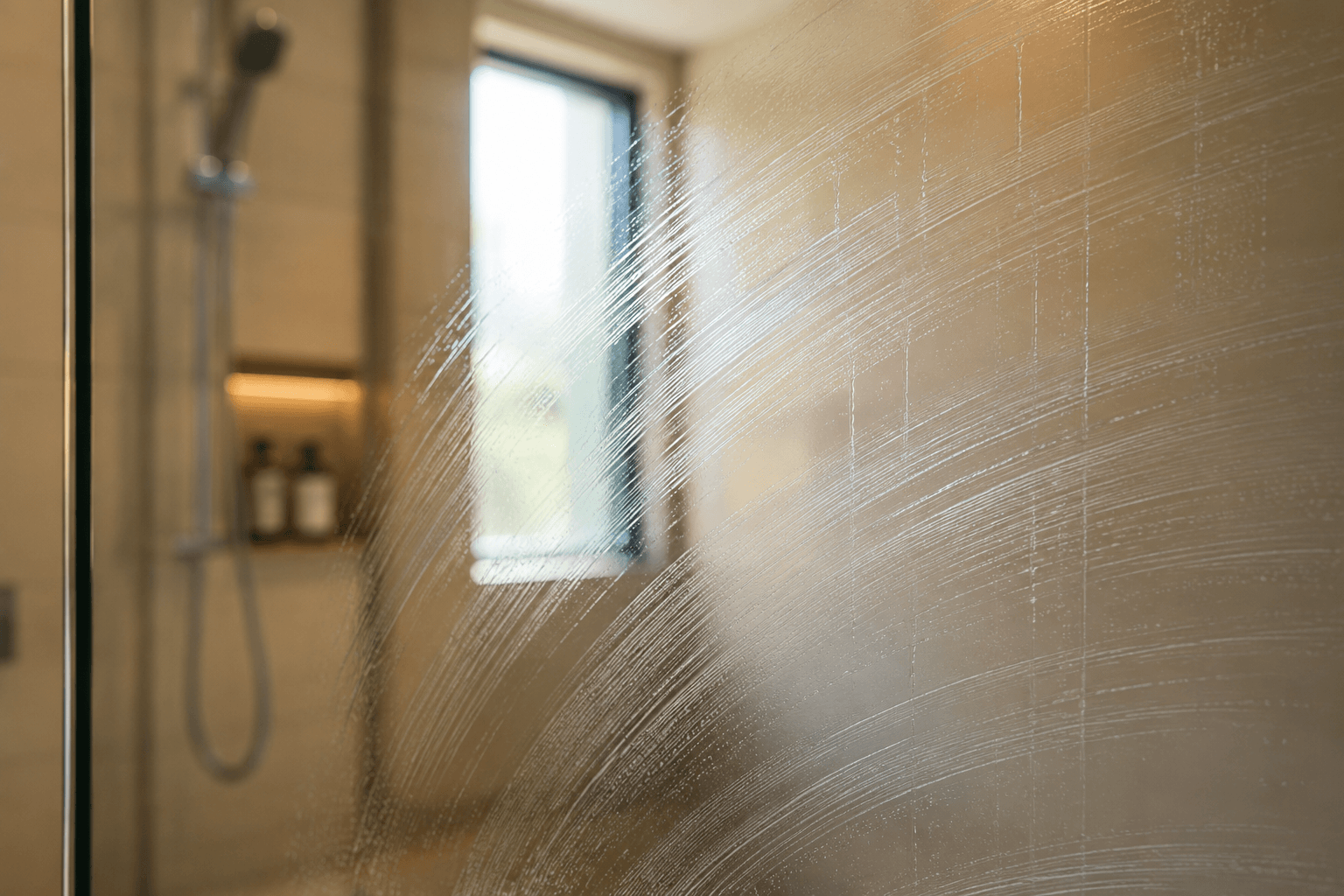
Streaks after cleaning have three causes, ranked by likelihood. One: you’re wiping in circles instead of straight downward strokes (most common). Two: your microfibre cloth is past its useful life or has been washed with fabric softener. Three: your rinse water itself is hard, so streaks form during drying. The first two are fixable in 5 minutes. The third needs a different approach.
You spend 15 minutes cleaning the shower glass. Looks clean while wet. As soon as it dries, streaks everywhere. Frustrating.
The streaks aren’t random — they always come from one of three specific causes. Diagnose first, then fix.
Cause 1: Wiping technique (most common)
If your streaks look like curved swirls or circular patterns, you’re wiping in circles. Almost everyone does this naturally — it feels efficient.
It’s actually the wrong technique for glass. Each circular motion leaves a thin film of soap or cleaner residue in arcs. As the glass dries, those arcs become visible.
Fix: Switch to straight downward strokes. Start top-left, pull straight down to the bottom. Move 15cm right, slight overlap, straight down again. Never side-to-side. Never circles.
This single technique change eliminates ~70% of streak problems.
Cause 2: Microfibre cloth condition
Microfibre cloths trap dirt by static cling. After about 50 washes, they lose their grip and start smearing instead of grabbing. They look fine but don’t work.
Two specific problems kill microfibre faster:
- Fabric softener. Coats the fibres in a waxy film. Even brand-new microfibre washed with softener once becomes useless. Fabric softener KILLS microfibre.
- Washing with cotton towels. Cotton lint sticks to microfibre. Wash microfibre separately or with other microfibre only.
How to check if yours is dead: Hold a clean microfibre under running tap water. If water beads off the surface (doesn’t absorb instantly), the cloth is contaminated with softener residue and won’t clean properly.
Fix: Replace with new microfibre (Daiso 4-pack RM 5.90). Wash separately, no fabric softener ever.
Cause 3: Hard rinse water
If technique is correct and microfibre is fresh, the third cause is the water you’re rinsing with. Malaysian tap water has minerals (calcium, magnesium). As the rinse water evaporates, those minerals deposit on the glass as a thin film.
You see this as uniform haziness or fine dotted streaks across the entire panel — not localised swirls.
Fix options:
- Distilled water final rinse. A small spray bottle of distilled water (RM 8 at most pharmacies) for the final rinse pass. Distilled water has no minerals to deposit. Eliminates streaks completely.
- Squeegee immediately, don’t let air-dry. If you squeegee within 30 seconds of rinsing, you remove the water before minerals can deposit.
- Long-term: glass coating. A coating like EnduroShield creates a hydrophobic surface where water beads and runs off, preventing the residue deposit pattern.
Putting it all together
The correct cleaning sequence to avoid streaks:
- Spray cleaning solution onto glass (dish soap or vinegar dilution).
- Wait the recommended time (5 minutes for vinegar, 2 minutes for dish soap).
- Wipe with fresh microfibre, straight downward strokes only, never circles.
- Rinse with warm water from showerhead.
- Within 30 seconds, squeegee dry, top-to-bottom.
- If you want zero streaks: spray distilled water briefly after squeegee, let air-dry.
Total time including all steps: about 5-6 minutes per panel. Result: completely clear glass without streaks.
The streak-free shortcut
Honestly, if streaks are a recurring frustration, a glass coating eliminates the problem permanently. Coated glass doesn’t form streaks because:
- Soap rinses off cleanly, no film left.
- Water beads instead of sheeting, less surface area for mineral deposit.
- Less cleaning effort = less risk of bad technique.
EnduroShield’s DIY kit applies in 10-30 minutes and lasts about 3 years. After application, your weekly clean drops to about 2 minutes and streaks become rare.
Want free delivery on your first order?
Drop your email. We send you the code now, and you use it on your first order.
Send me the code →Frequently asked questions
Why are my streaks worse in dry season vs wet season?
Faster evaporation in dry season leaves minerals on the glass before you can wipe them off. Wet season’s higher humidity means water sits longer, gets squeegeed off before drying. The fix (distilled rinse OR coating) eliminates this seasonal variation.
Can I use newspaper instead of microfibre?
Old trick — works OK for windows because ink residue actually fills micro-scratches in older glass. On modern frameless shower glass it’s less effective and leaves ink streaks. Microfibre is better for shower glass.
What about “streak-free” glass cleaners?
They help but don’t fully solve the problem. Most contain a small amount of alcohol that evaporates fast, leaving less residue. Still depends on technique + microfibre condition. Hagerty Mr Glass (RM 28 Shopee) is the best of the streak-free formulas I’ve tested in Malaysia.
How do I know if it’s streak or actual etching?
Streak: visible only when dry, wipes off with another cleaning pass. Etching: visible always, doesn’t come off with cleaning. If you can’t wipe it away no matter what you try, it’s not a streak — it’s permanent damage. Different fix entirely (see our cloudy glass fix guide).