How to Remove Hard Water Stains from Shower Glass (Without Ruining It)
Shower screen stains and shower screen water stains on Malaysian glass are almost always hard-water minerals — here’s how to remove them safely.
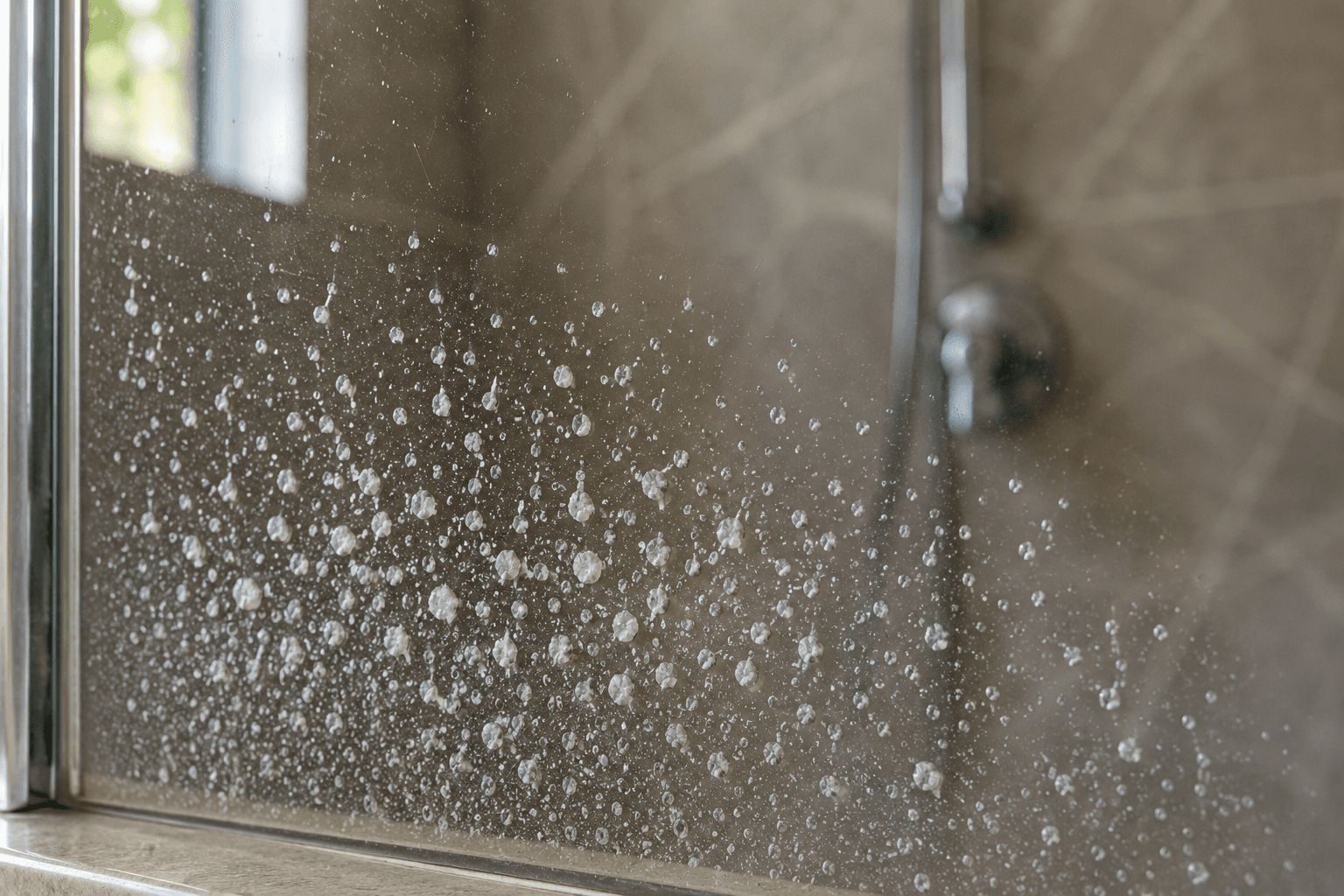
Hard water stains on shower glass split into two types: still on the surface (fixable with vinegar in 5 minutes) and fused into the silica (permanent, needs polish or replacement). Before you start scrubbing or buying products, do the fingernail test. If the spots feel rough, vinegar fixes it. If the glass feels smooth but hazy, you’re too late — this guide tells you what to do then.
The first thing you need to know about hard water stains is that not all of them are the same problem.
If you start scrubbing with the wrong product, you can make permanent damage worse, scratch the surface, or just waste 40 minutes for nothing. So before any fix, run a 5-second diagnostic.
The 5-second fingernail test
Stand close to the glass in good light. Pick a stain. Run your fingernail across it.
- If it feels rough or bumpy under your nail — the minerals are still sitting on the surface. Vinegar method below works.
- If it feels smooth but the glass still looks hazy or foggy — the minerals have chemically fused INTO the silica. Vinegar will do nothing. Skip to the “Already permanent” section.
This 5 seconds saves you from buying RM 80 of cerium polish kit when vinegar would have worked, or from spending an hour on vinegar when only polish can help.
Fix 1: White vinegar (rough/bumpy spots)
You need: plain white vinegar (about RM 3.50 at any sundry shop — not flavoured rice vinegar, the sugar in rice vinegar leaves a film), a spray bottle, microfibre cloth (Daiso 4-pack RM 5.90), and warm water.
- Mix 1:1 white vinegar and warm water in the spray bottle. About 50ml each is enough for a standard panel.
- Spray onto the affected area until lightly wet.
- Wait 5 minutes. This is the part most people skip. The acid needs time to dissolve the mineral deposits.
- Wipe with microfibre cloth in straight downward strokes. Never circles — circles leave swirl marks.
- Rinse thoroughly with plain warm water. Don’t skip the rinse. Vinegar residue attracts dust and stays sticky.
- Squeegee dry, top to bottom.
One panel takes about 8 minutes including the wait.
Stubborn spots: the soak method
If the vinegar spray didn’t fully remove a patch after one try, don’t spray harder — soak instead.
- Soak a piece of paper towel in undiluted white vinegar.
- Press the wet paper towel directly against the spot.
- Leave it pressed against the glass for 15 minutes. (Use a piece of cling wrap to hold it if it’s on a vertical panel.)
- Peel off, wipe with microfibre, rinse thoroughly, squeegee dry.
For really stubborn ones, repeat 2-3 times across a weekend. It should improve each time.
What NOT to use
- Scratchy sponge / scouring pad. You’re literally sanding the glass — permanently scratching the surface. Whatever you scrub off, you’ve also damaged the glass underneath.
- Bathroom cleaner with limescale remover. The chemistry is too aggressive. Over months it micro-etches the surface. By year 2 your glass looks hazy even when it’s clean.
- Toothpaste. Old internet hack — it’s mildly abrasive (designed for tooth enamel), but on glass it just leaves white streaks and doesn’t dissolve minerals.
- Bleach. Doesn’t touch mineral deposits at all. Just weakens the surrounding silicone.
Already permanent? Here are your options
If the fingernail test shows smooth-but-hazy — minerals have fused into the silica — you have three options, ranked by cost and effort.
1. DIY cerium oxide polishing kit (RM 80-150)
Cerium oxide is the mineral used by professionals to polish glass. Shopee sells DIY kits for around RM 80-150. The kit comes with cerium powder, a felt pad, and instructions. Realistic time: about 2 hours per panel. Results vary — if the etching is shallow, this works well. If it’s deep, you’ll see improvement but maybe not full restoration.
2. Professional glass polishing (RM 500-1,200 per panel)
In Klang Valley, professional glass restoration runs RM 500-1,200 per panel depending on damage depth. They use industrial cerium machines that do in 20 minutes what DIY takes 2 hours, with better results. Best for visible heavy etching or shower glass over 3 years old.
3. Replace the panel (RM 1,200-3,000)
If etching is severe across multiple panels, the math sometimes favours replacement. A new frameless 90cm panel runs RM 1,200-3,000 installed in KL. Painful, but at least you start fresh.
Whichever you pick, do the next step — otherwise you’re back here in 24 months.
How to stop this happening again
The reason hard water stains keep coming back is that Malaysian tap water never stops carrying calcium and magnesium minerals. You either build a daily habit that removes water before it evaporates, or you put a barrier on the glass so minerals can’t bond to the silica.
The daily habit: 30-second squeegee after every shower. Top-to-bottom strokes only. A Vileda 27cm squeegee from Tesco runs about RM 19.90 and lasts 6 months of daily use. This single habit prevents 80% of recurring hard water stains.
The barrier option: a glass coating like EnduroShield. One application bonds chemically to the glass and blocks mineral fusion for about 3 years. Cuts your cleaning effort by about 60%. Read about the DIY kit here. Best applied within 30 days of new installation — if your glass is already etched, polish first.
Want free delivery on your first order?
Drop your email. We send you the code now, and you use it on your first order.
Send me the code →Frequently asked questions
Why does my shower glass get hard water stains so quickly in Malaysia?
Malaysian tap water carries higher mineral loads than soft-water regions because the limestone bedrock in many treatment-plant catchment areas raises calcium and magnesium. Daily shower use plus tropical humidity means the minerals deposit and evaporate fast — you’ll see visible spots within weeks of new glass if there’s no protection or daily squeegee.
How often should I do the vinegar treatment?
As prevention: once a week as part of the 5-minute weekly clean. As cure (when stains are visible): until the spots are gone. After that, switch to the daily 30-second squeegee habit. You shouldn’t need vinegar more than monthly if the daily habit is solid.
Will vinegar damage the silicone or grout around my shower glass?
Vinegar is safe on glass and tile grout in normal dilutions. It does damage natural stone (marble, travertine), brass fittings, and unsealed natural materials. If your shower frame is brass or your floor is unsealed marble, avoid vinegar near those surfaces — or rinse thoroughly within 30 seconds.
What’s the difference between hard water stains and soap scum?
Hard water stains are mineral deposits (calcium, magnesium) — they look like white, chalky spots. Soap scum is a sticky film from soap residue mixing with hard water — it looks like a foggy, oily coating. Soap scum responds best to dish-soap warm-water method; mineral stains need vinegar.